

Sienam Ahuja Lulla

CEO Bryckel AI

Your Lease Portfolio Is Organized. Your Team Still Can't Find What They Need
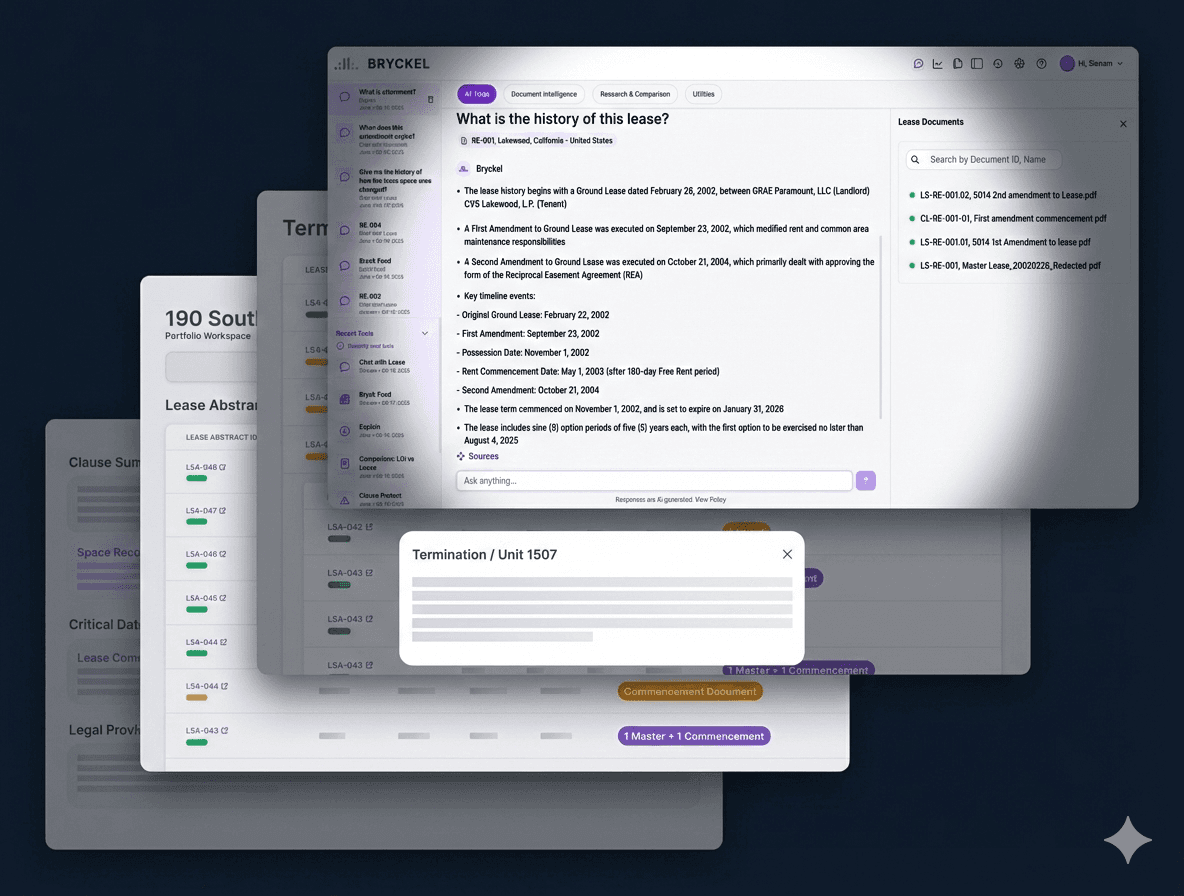
Lease administration software organizes your documents — but asset management teams still spend hours rebuilding lease intelligence before every deal.

Lease administration software organizes your documents — but asset management teams still spend hours rebuilding lease intelligence before every deal.

Your Lease Portfolio Is Organized. Your Team Still Can't Find What They Need.

A new leasing opportunity arrives. A prospective tenant, a compelling use, real urgency on their side. For most landlords, this is the moment the clock starts — not on the deal, but on the research.

Before anyone can negotiate intelligently, someone has to go find what you actually have.

What a Deal Actually Requires Before It Begins

The leasing team needs to pull the relevant lease and locate the use restrictions. The space might already be restricted in ways that eliminate this prospect entirely — and nobody remembers offhand. If the space isn't a fit, someone needs to identify relocation opportunities, which means understanding what other tenants are movable and what rights they hold. To anchor deal economics, someone needs to find the last comparable transaction — the terms on a similar inline space, the TI package, the lease structure — so the team isn't negotiating blind. And if relocation is on the table, the asset team needs to calculate what incentive makes sense to move an existing tenant, which means surfacing their remaining term, current rent, improvement history, and co-tenancy exposure.

None of this is the deal. All of it has to happen before the deal can meaningfully begin.

And it's happening across the leasing team, the asset management team, and outside counsel — often in parallel, often redundantly, each party reconstructing a picture of the same portfolio from their own partial view of the files.

The Portfolio Looks Organized Until You Need It

Most landlords have infrastructure that looks solid on the surface. Leases live in a Z drive or a platform like MRI or Yardi. Abstracts exist. Counsel has copies. The asset team has copies. The leasing team has copies.

But portfolios are living things, and over time the clean architecture drifts. People come and go, and institutional knowledge walks out with them. An option letter gets sent and never filed against the original lease. A waiver gets negotiated informally and noted in a deal memo that doesn't quite connect back to the master record. A system migration creates duplicates and nobody is certain which version governs. A side letter addresses a specific tenant concern and then gets overlooked five years later when that tenant raises the same issue again.

The documents exist, somewhere. But the coherent picture of what you actually have — what rights you've granted, what obligations you've taken on, what flexibility genuinely remains — has to be assembled by a person, every time, from wherever the fragments happen to live.

The People Problem Is As Significant As the Technology Problem

Leases are long-lived instruments. A lease signed fifteen years ago may have been amended four times, extended twice, and passed through three leasing directors, two asset managers, and outside counsel that has turned over more than once. Every transition is an opportunity for context to be lost, for documents to be misfiled, and for the integrated understanding of that relationship to exist only in the memory of someone who may no longer be with the organization.

This isn't negligence. It's the natural result of complex, long-duration relationships moving through many hands over time. But the cost materializes every time someone needs to understand what a lease actually means today — not what it said when it was signed, but what it says now, in light of everything that has happened since.

For asset management teams, this creates persistent exposure. Decisions about renewals, relocations, redevelopment, and capital allocation depend on understanding the current state of lease rights across the portfolio. When that understanding has to be reconstructed rather than accessed, decision quality depends heavily on who happens to remember what — and on how much time is available before a deadline forces the issue.

The Scale Problem

At a small portfolio, experienced professionals can carry much of this in their heads. They remember the tricky exclusives at a particular center. They know which anchor has co-tenancy rights that complicate leasing the east wing. They recall the terms of the last inline deal done two years ago.

At fifty to a hundred properties, that mental model becomes impossible to maintain. The same reconstruction work required for one deal gets multiplied across an entire portfolio in motion. Every new leasing opportunity triggers a research process. Every relocation conversation requires rebuilding understanding of two situations simultaneously. Every renewal negotiation requires locating comparable precedent from transactions that might be years old, documented by people who are no longer in the organization.

The leasing team, asset management team, and counsel are each doing versions of this work, often without a shared integrated picture to anchor from. Time gets spent reconciling different partial understandings rather than advancing the transaction.

The Cognitive Load Nobody Accounts For

The time cost of this reconstruction work is real and measurable. The cognitive cost is harder to see but equally significant. Assembling a coherent picture from fragmented sources — cross-referencing abstracts against original documents, reconciling what the system shows against what counsel recalls, verifying whether an informal waiver ever made it into the official record — requires sustained concentration. It demands holding multiple partial pieces in mind simultaneously while continuing to search for what's missing. By the time the picture is assembled, the mental energy available for the work that actually requires judgment — evaluating deal structure, anticipating tenant behavior, thinking through downside scenarios — has already been partially spent. At scale, across a large portfolio with active leasing activity, asset management teams can find themselves in a mode where a disproportionate share of cognitive capacity is devoted to remembering and reconstructing rather than analyzing and deciding. The most valuable thinking gets crowded out not by bad prioritization, but by the sheer volume of assembly work that precedes it.

The Cost That Doesn't Appear on Any Report

This assembly time rarely surfaces as a distinct line item. It gets absorbed into deal timelines, billed across dozens of counsel emails and calls, or treated as simply the normal overhead of managing a complex portfolio.

But it accumulates in ways that matter. A leasing director spending several hours on pre-deal research before every serious conversation, across a portfolio with active leasing activity at dozens of properties, is spending a substantial share of her working capacity on reconstruction rather than negotiation and relationship work. Outside counsel billing time to answer questions that are fundamentally about what documents already say is an expensive way to access information that should be immediately available. Asset managers pulled in to provide context from memory are being diverted from the forward-looking analysis their role demands.

The downstream effects are harder to quantify but real: deals that move more slowly than competitive situations require, negotiating positions formed on incomplete information, and tenant relationships that suffer when the landlord team appears less prepared than expected.

What Better Document Management Doesn't Solve

The instinct when facing this problem is to invest in better systems — more rigorous filing protocols, improved naming conventions, a more capable lease administration platform. These investments have genuine value. Locating information faster during reconstruction is meaningfully better than locating it slowly.

But better organization changes the efficiency of the reconstruction process without changing its fundamental nature. The core issue isn't that documents are difficult to find. It's that integrated understanding of a lease — its current state, its key restrictions, its amendment history, its relationship to other leases in the portfolio — has to be rebuilt each time rather than persisting in a form that can be immediately accessed and applied.

Every time a new opportunity arrives, the clock starts on research rather than on the deal itself. Every time a team member transitions out, a portion of the portfolio's understood state leaves with them. Every time outside counsel gets pulled in to answer a question about existing rights, the cost of not having that understanding readily available becomes visible for a moment before being absorbed back into normal operating overhead.

The question worth considering is whether this represents an unavoidable cost of managing complex lease portfolios, or whether the architecture itself — where documents persist but integrated understanding must be constantly rebuilt — is ready for a different approach.

Your Lease Portfolio Is Organized. Your Team Still Can't Find What They Need.

A new leasing opportunity arrives. A prospective tenant, a compelling use, real urgency on their side. For most landlords, this is the moment the clock starts — not on the deal, but on the research.

Before anyone can negotiate intelligently, someone has to go find what you actually have.

What a Deal Actually Requires Before It Begins

The leasing team needs to pull the relevant lease and locate the use restrictions. The space might already be restricted in ways that eliminate this prospect entirely — and nobody remembers offhand. If the space isn't a fit, someone needs to identify relocation opportunities, which means understanding what other tenants are movable and what rights they hold. To anchor deal economics, someone needs to find the last comparable transaction — the terms on a similar inline space, the TI package, the lease structure — so the team isn't negotiating blind. And if relocation is on the table, the asset team needs to calculate what incentive makes sense to move an existing tenant, which means surfacing their remaining term, current rent, improvement history, and co-tenancy exposure.

None of this is the deal. All of it has to happen before the deal can meaningfully begin.

And it's happening across the leasing team, the asset management team, and outside counsel — often in parallel, often redundantly, each party reconstructing a picture of the same portfolio from their own partial view of the files.

The Portfolio Looks Organized Until You Need It

Most landlords have infrastructure that looks solid on the surface. Leases live in a Z drive or a platform like MRI or Yardi. Abstracts exist. Counsel has copies. The asset team has copies. The leasing team has copies.

But portfolios are living things, and over time the clean architecture drifts. People come and go, and institutional knowledge walks out with them. An option letter gets sent and never filed against the original lease. A waiver gets negotiated informally and noted in a deal memo that doesn't quite connect back to the master record. A system migration creates duplicates and nobody is certain which version governs. A side letter addresses a specific tenant concern and then gets overlooked five years later when that tenant raises the same issue again.

The documents exist, somewhere. But the coherent picture of what you actually have — what rights you've granted, what obligations you've taken on, what flexibility genuinely remains — has to be assembled by a person, every time, from wherever the fragments happen to live.

The People Problem Is As Significant As the Technology Problem

Leases are long-lived instruments. A lease signed fifteen years ago may have been amended four times, extended twice, and passed through three leasing directors, two asset managers, and outside counsel that has turned over more than once. Every transition is an opportunity for context to be lost, for documents to be misfiled, and for the integrated understanding of that relationship to exist only in the memory of someone who may no longer be with the organization.

This isn't negligence. It's the natural result of complex, long-duration relationships moving through many hands over time. But the cost materializes every time someone needs to understand what a lease actually means today — not what it said when it was signed, but what it says now, in light of everything that has happened since.

For asset management teams, this creates persistent exposure. Decisions about renewals, relocations, redevelopment, and capital allocation depend on understanding the current state of lease rights across the portfolio. When that understanding has to be reconstructed rather than accessed, decision quality depends heavily on who happens to remember what — and on how much time is available before a deadline forces the issue.

The Scale Problem

At a small portfolio, experienced professionals can carry much of this in their heads. They remember the tricky exclusives at a particular center. They know which anchor has co-tenancy rights that complicate leasing the east wing. They recall the terms of the last inline deal done two years ago.

At fifty to a hundred properties, that mental model becomes impossible to maintain. The same reconstruction work required for one deal gets multiplied across an entire portfolio in motion. Every new leasing opportunity triggers a research process. Every relocation conversation requires rebuilding understanding of two situations simultaneously. Every renewal negotiation requires locating comparable precedent from transactions that might be years old, documented by people who are no longer in the organization.

The leasing team, asset management team, and counsel are each doing versions of this work, often without a shared integrated picture to anchor from. Time gets spent reconciling different partial understandings rather than advancing the transaction.

The Cognitive Load Nobody Accounts For

The time cost of this reconstruction work is real and measurable. The cognitive cost is harder to see but equally significant. Assembling a coherent picture from fragmented sources — cross-referencing abstracts against original documents, reconciling what the system shows against what counsel recalls, verifying whether an informal waiver ever made it into the official record — requires sustained concentration. It demands holding multiple partial pieces in mind simultaneously while continuing to search for what's missing. By the time the picture is assembled, the mental energy available for the work that actually requires judgment — evaluating deal structure, anticipating tenant behavior, thinking through downside scenarios — has already been partially spent. At scale, across a large portfolio with active leasing activity, asset management teams can find themselves in a mode where a disproportionate share of cognitive capacity is devoted to remembering and reconstructing rather than analyzing and deciding. The most valuable thinking gets crowded out not by bad prioritization, but by the sheer volume of assembly work that precedes it.

The Cost That Doesn't Appear on Any Report

This assembly time rarely surfaces as a distinct line item. It gets absorbed into deal timelines, billed across dozens of counsel emails and calls, or treated as simply the normal overhead of managing a complex portfolio.

But it accumulates in ways that matter. A leasing director spending several hours on pre-deal research before every serious conversation, across a portfolio with active leasing activity at dozens of properties, is spending a substantial share of her working capacity on reconstruction rather than negotiation and relationship work. Outside counsel billing time to answer questions that are fundamentally about what documents already say is an expensive way to access information that should be immediately available. Asset managers pulled in to provide context from memory are being diverted from the forward-looking analysis their role demands.

The downstream effects are harder to quantify but real: deals that move more slowly than competitive situations require, negotiating positions formed on incomplete information, and tenant relationships that suffer when the landlord team appears less prepared than expected.

What Better Document Management Doesn't Solve

The instinct when facing this problem is to invest in better systems — more rigorous filing protocols, improved naming conventions, a more capable lease administration platform. These investments have genuine value. Locating information faster during reconstruction is meaningfully better than locating it slowly.

But better organization changes the efficiency of the reconstruction process without changing its fundamental nature. The core issue isn't that documents are difficult to find. It's that integrated understanding of a lease — its current state, its key restrictions, its amendment history, its relationship to other leases in the portfolio — has to be rebuilt each time rather than persisting in a form that can be immediately accessed and applied.

Every time a new opportunity arrives, the clock starts on research rather than on the deal itself. Every time a team member transitions out, a portion of the portfolio's understood state leaves with them. Every time outside counsel gets pulled in to answer a question about existing rights, the cost of not having that understanding readily available becomes visible for a moment before being absorbed back into normal operating overhead.

The question worth considering is whether this represents an unavoidable cost of managing complex lease portfolios, or whether the architecture itself — where documents persist but integrated understanding must be constantly rebuilt — is ready for a different approach.

Your Lease Portfolio Is Organized. Your Team Still Can't Find What They Need.

A new leasing opportunity arrives. A prospective tenant, a compelling use, real urgency on their side. For most landlords, this is the moment the clock starts — not on the deal, but on the research.

Before anyone can negotiate intelligently, someone has to go find what you actually have.

What a Deal Actually Requires Before It Begins

The leasing team needs to pull the relevant lease and locate the use restrictions. The space might already be restricted in ways that eliminate this prospect entirely — and nobody remembers offhand. If the space isn't a fit, someone needs to identify relocation opportunities, which means understanding what other tenants are movable and what rights they hold. To anchor deal economics, someone needs to find the last comparable transaction — the terms on a similar inline space, the TI package, the lease structure — so the team isn't negotiating blind. And if relocation is on the table, the asset team needs to calculate what incentive makes sense to move an existing tenant, which means surfacing their remaining term, current rent, improvement history, and co-tenancy exposure.

None of this is the deal. All of it has to happen before the deal can meaningfully begin.

And it's happening across the leasing team, the asset management team, and outside counsel — often in parallel, often redundantly, each party reconstructing a picture of the same portfolio from their own partial view of the files.

The Portfolio Looks Organized Until You Need It

Most landlords have infrastructure that looks solid on the surface. Leases live in a Z drive or a platform like MRI or Yardi. Abstracts exist. Counsel has copies. The asset team has copies. The leasing team has copies.

But portfolios are living things, and over time the clean architecture drifts. People come and go, and institutional knowledge walks out with them. An option letter gets sent and never filed against the original lease. A waiver gets negotiated informally and noted in a deal memo that doesn't quite connect back to the master record. A system migration creates duplicates and nobody is certain which version governs. A side letter addresses a specific tenant concern and then gets overlooked five years later when that tenant raises the same issue again.

The documents exist, somewhere. But the coherent picture of what you actually have — what rights you've granted, what obligations you've taken on, what flexibility genuinely remains — has to be assembled by a person, every time, from wherever the fragments happen to live.

The People Problem Is As Significant As the Technology Problem

Leases are long-lived instruments. A lease signed fifteen years ago may have been amended four times, extended twice, and passed through three leasing directors, two asset managers, and outside counsel that has turned over more than once. Every transition is an opportunity for context to be lost, for documents to be misfiled, and for the integrated understanding of that relationship to exist only in the memory of someone who may no longer be with the organization.

This isn't negligence. It's the natural result of complex, long-duration relationships moving through many hands over time. But the cost materializes every time someone needs to understand what a lease actually means today — not what it said when it was signed, but what it says now, in light of everything that has happened since.

For asset management teams, this creates persistent exposure. Decisions about renewals, relocations, redevelopment, and capital allocation depend on understanding the current state of lease rights across the portfolio. When that understanding has to be reconstructed rather than accessed, decision quality depends heavily on who happens to remember what — and on how much time is available before a deadline forces the issue.

The Scale Problem

At a small portfolio, experienced professionals can carry much of this in their heads. They remember the tricky exclusives at a particular center. They know which anchor has co-tenancy rights that complicate leasing the east wing. They recall the terms of the last inline deal done two years ago.

At fifty to a hundred properties, that mental model becomes impossible to maintain. The same reconstruction work required for one deal gets multiplied across an entire portfolio in motion. Every new leasing opportunity triggers a research process. Every relocation conversation requires rebuilding understanding of two situations simultaneously. Every renewal negotiation requires locating comparable precedent from transactions that might be years old, documented by people who are no longer in the organization.

The leasing team, asset management team, and counsel are each doing versions of this work, often without a shared integrated picture to anchor from. Time gets spent reconciling different partial understandings rather than advancing the transaction.

The Cognitive Load Nobody Accounts For

The time cost of this reconstruction work is real and measurable. The cognitive cost is harder to see but equally significant. Assembling a coherent picture from fragmented sources — cross-referencing abstracts against original documents, reconciling what the system shows against what counsel recalls, verifying whether an informal waiver ever made it into the official record — requires sustained concentration. It demands holding multiple partial pieces in mind simultaneously while continuing to search for what's missing. By the time the picture is assembled, the mental energy available for the work that actually requires judgment — evaluating deal structure, anticipating tenant behavior, thinking through downside scenarios — has already been partially spent. At scale, across a large portfolio with active leasing activity, asset management teams can find themselves in a mode where a disproportionate share of cognitive capacity is devoted to remembering and reconstructing rather than analyzing and deciding. The most valuable thinking gets crowded out not by bad prioritization, but by the sheer volume of assembly work that precedes it.

The Cost That Doesn't Appear on Any Report

This assembly time rarely surfaces as a distinct line item. It gets absorbed into deal timelines, billed across dozens of counsel emails and calls, or treated as simply the normal overhead of managing a complex portfolio.

But it accumulates in ways that matter. A leasing director spending several hours on pre-deal research before every serious conversation, across a portfolio with active leasing activity at dozens of properties, is spending a substantial share of her working capacity on reconstruction rather than negotiation and relationship work. Outside counsel billing time to answer questions that are fundamentally about what documents already say is an expensive way to access information that should be immediately available. Asset managers pulled in to provide context from memory are being diverted from the forward-looking analysis their role demands.

The downstream effects are harder to quantify but real: deals that move more slowly than competitive situations require, negotiating positions formed on incomplete information, and tenant relationships that suffer when the landlord team appears less prepared than expected.

What Better Document Management Doesn't Solve

The instinct when facing this problem is to invest in better systems — more rigorous filing protocols, improved naming conventions, a more capable lease administration platform. These investments have genuine value. Locating information faster during reconstruction is meaningfully better than locating it slowly.

But better organization changes the efficiency of the reconstruction process without changing its fundamental nature. The core issue isn't that documents are difficult to find. It's that integrated understanding of a lease — its current state, its key restrictions, its amendment history, its relationship to other leases in the portfolio — has to be rebuilt each time rather than persisting in a form that can be immediately accessed and applied.

Every time a new opportunity arrives, the clock starts on research rather than on the deal itself. Every time a team member transitions out, a portion of the portfolio's understood state leaves with them. Every time outside counsel gets pulled in to answer a question about existing rights, the cost of not having that understanding readily available becomes visible for a moment before being absorbed back into normal operating overhead.

The question worth considering is whether this represents an unavoidable cost of managing complex lease portfolios, or whether the architecture itself — where documents persist but integrated understanding must be constantly rebuilt — is ready for a different approach.

Learn more about Bryckel AI.

Trusted by hundreds of leading real estate businesses.

Book a Demo

By submitting this form you agree to our terms and conditions and our Privacy Policy which explains how we may collect, use and disclose your personal information including to third parties.

In-house Legal

Move at the pace your business requires while ensuring every decision is informed and defensible. Handle more work with less resources. Reduce your external counsel spend, invest in codifying expertise across deals for future efficiency.

Real Estate Development Team

Fast growing tenants in industries such as restaurant, retail, fitness, banking, grocery, logistics and coworking. Never sign an unfavorable lease. Speed up lease approvals, streamline negotiations, and manage multiple locations with confidence.

Real Estate Investors & Asset Managers

Never miss an acquisition opportunity. Maximize NOI & monetization opportunities. Respond to investors, leasing team, brokers, outside counsel and leadership in fraction of time.

Real Estate Advisors

For anyone who loves deals, not documents. Get your head around complex leases and portfolios, and advise clients about issues from day one. Deliver actionable insights and strategic advice that accelerates deals and strengthens client relationships.

Law Firms

Spot issues before they become problems, watch your clients’ back and protect their business. Meet tight client deadlines. Handle work at scale and stay competitive.

Learn more about Bryckel AI.

Trusted by hundreds of leading real estate businesses.

Book a Demo

By submitting this form you agree to our terms and conditions and our Privacy Policy which explains how we may collect, use and disclose your personal information including to third parties.

In-house Legal

Move at the pace your business requires while ensuring every decision is informed and defensible. Handle more work with less resources. Reduce your external counsel spend, invest in codifying expertise across deals for future efficiency.

Real Estate Development Team

Fast growing tenants in industries such as restaurant, retail, fitness, banking, grocery, logistics and coworking. Never sign an unfavorable lease. Speed up lease approvals, streamline negotiations, and manage multiple locations with confidence.

Real Estate Investors & Asset Managers

Never miss an acquisition opportunity. Maximize NOI & monetization opportunities. Respond to investors, leasing team, brokers, outside counsel and leadership in fraction of time.

Real Estate Advisors

For anyone who loves deals, not documents. Get your head around complex leases and portfolios, and advise clients about issues from day one. Deliver actionable insights and strategic advice that accelerates deals and strengthens client relationships.

Law Firms

Spot issues before they become problems, watch your clients’ back and protect their business. Meet tight client deadlines. Handle work at scale and stay competitive.

Learn more about Bryckel AI.

Trusted by hundreds of leading real estate businesses.

Book a Demo

By submitting this form you agree to our terms and conditions and our Privacy Policy which explains how we may collect, use and disclose your personal information including to third parties.

In-house Legal

Move at the pace your business requires while ensuring every decision is informed and defensible. Handle more work with less resources. Reduce your external counsel spend, invest in codifying expertise across deals for future efficiency.

Real Estate Development Team

Fast growing tenants in industries such as restaurant, retail, fitness, banking, grocery, logistics and coworking. Never sign an unfavorable lease. Speed up lease approvals, streamline negotiations, and manage multiple locations with confidence.

Real Estate Investors & Asset Managers

Never miss an acquisition opportunity. Maximize NOI & monetization opportunities. Respond to investors, leasing team, brokers, outside counsel and leadership in fraction of time.

Real Estate Advisors

For anyone who loves deals, not documents. Get your head around complex leases and portfolios, and advise clients about issues from day one. Deliver actionable insights and strategic advice that accelerates deals and strengthens client relationships.

Law Firms

Spot issues before they become problems, watch your clients’ back and protect their business. Meet tight client deadlines. Handle work at scale and stay competitive.