

Sienam Ahuja Lulla

CEO Bryckel AI

AI in Commercial Real Estate
For shopping center owners and fast-growing retail tenants who are tired of hearing about AI and ready to do something with it.

For shopping center owners and fast-growing retail tenants who are tired of hearing about AI and ready to do something with it.

Everyone Is Using AI. Most Businesses Aren't. Here's How to Actually Get It Right in Commercial Real Estate.

By now you've used ChatGPT. You've seen the headlines. You probably have a few people on your team who swear by it and a few who ignore it entirely.

Here's what the data actually shows: one in six people worldwide now use generative AI tools in their daily lives. Consumer adoption is at an all-time high. ChatGPT alone hit 400 million monthly users in early 2025.

But individual use and business adoption are two completely different things. Across the OECD, only 20% of firms have actually deployed AI at an organizational level. And in commercial real estate — shopping centers, retail, industrial — the gap is even more glaring.

76% of CRE firms say they're exploring or implementing AI. Only 5% say they've actually hit their goals.

That's not a technology problem. That's a strategy and execution problem. And it's exactly what this piece is about.

Why CRE Is Such a Good Fit — and Still Getting It Wrong

If you run shopping centers or a growing retail portfolio, you are sitting on some of the most AI-ready data in any industry: leases, rent rolls, tenant sales reports, maintenance logs, deal pipelines. This is exactly the kind of information AI was built to work with.

The opportunity is real. JLL surveyed 1,500+ senior CRE decision-makers in 2025 and found that nearly 90% are running AI pilots. Two years ago that number was 5%. The acceleration is genuinely historic.

And yet — only 5% are achieving their goals. Most pilots quietly stall. Most tools go underused. Most organizations are paying for AI and not getting value from it.

So what's actually going wrong?

Why AI Pilots Die (And It's Almost Never the Technology)

Here are the patterns we see fail repeatedly:

No specific problem to solve. Teams adopt AI because they feel behind, not because they've identified a broken workflow. A tool without a job becomes shelfware.

Messy data. AI can't abstract what it can't find. If your leases are in a mix of PDFs, email attachments, and someone's desktop, no AI tool will save you until that's fixed.

IT owns the rollout. When AI is treated as a technology project rather than a business change, business teams don't adopt it. Your IT person can configure a tool. They can't change how your leasing team actually works.

Piloting instead of deploying. A pilot that works in one property or one market proves the concept. It is not the destination. Organizations that stay in pilot mode indefinitely get no ROI and build no capability.

Skipping the people part. IBM's research found that lack of AI skills (33%) and data complexity (25%) are the top barriers to deployment — not access to tools. The tools are accessible. Preparing your people to use them is the work.

What "Ready" Actually Looks Like

Before picking tools, be honest about four things:

Your data. Can you actually find and access your leases, rent rolls, and deal history? Are they consistent? If your data is scattered and dirty, AI will surface that problem faster than anything else.

Your workflows. Do you know how work actually gets done on your team today? You can't automate — or reimagine — what hasn't been mapped. AI doesn't fix broken processes. It accelerates them.

Your leadership. Is there a decision-maker who owns this with a real business outcome in mind? AI initiatives without executive ownership and clear KPIs die in committee.

Your people. You don't need data scientists. You need people who are curious, capable, and willing to learn — and a plan to actually train them.

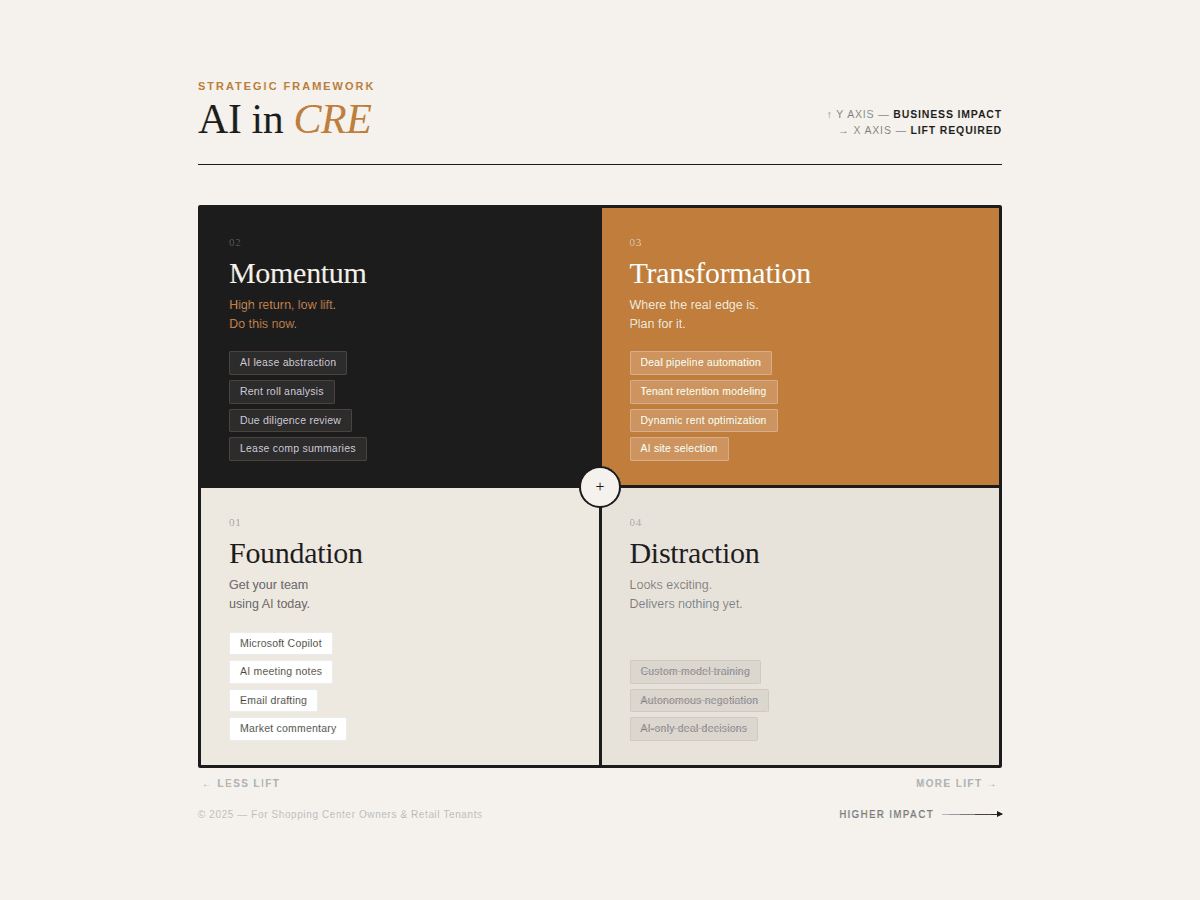
The Four-Quadrant Framework: Where to Start and What to Build Toward

Not all AI investments are equal. The smartest approach is to sequence your adoption based on two dimensions: how much value it delivers and how hard it is to implement.

Quadrant 1 — Start Here: Low Hanging Fruit (Easy + Moderate Value)

These are productivity tools that any team can use immediately with almost no implementation overhead. Deploy these now. They build AI fluency and return time to your team within weeks.

  • Microsoft Copilot for drafting emails, summarizing documents, and meeting notes

  • AI meeting transcription (Otter, Fireflies) so nothing falls through the cracks

  • AI scheduling and inbox management tools

This isn't transformational. It's the warm-up. But skipping it means your team arrives at more complex AI tools cold.

Quadrant 2 — Do Next: High Value + Easier to Implement

These tools deliver serious ROI and don't require you to reinvent your operations. They work on data and workflows you already have.

  • AI lease abstraction — tools that pull key dates, clauses, options, and obligations from leases in minutes, not days. For any shopping center owner managing 20+ leases, this alone pays for itself quickly.

  • Automated rent roll analysis — flag anomalies, track expirations, and model scenarios without a spreadsheet marathon

  • AI-assisted due diligence — review LOIs, PSAs, and estoppel certificates at speed

  • Lease comp analysis — pull and summarize market comparables from deal databases

  • Tenant sales reporting — AI tools that consolidate, clean, and flag underperformers from tenant sales data

These use cases have a clear input, a clear output, and proven vendor solutions. The implementation barrier is low. The value is high. Start here after your productivity layer is in place.

Quadrant 3 — Build Toward: High Value + Requires Workflow Redesign

These are the most transformational opportunities — but they require you to rethink how work gets done, not just add a tool to an existing process.

  • End-to-end deal pipeline automation — from prospect to executed lease with AI at every step

  • Predictive tenant retention modeling — identifying at-risk tenants before they give notice, using sales trends, foot traffic data, and lease history

  • Dynamic rent optimization — pricing vacancy based on real-time market signals and portfolio-wide data

  • AI-powered site selection for retail tenants — trade area analysis, cannibalization modeling, and demographic scoring at scale

  • Automated portfolio risk scoring — continuous monitoring of lease expiration concentration, tenant credit risk, and market exposure

These are genuinely game-changing. They also require clean integrated data, cross-functional buy-in, and 12-24 months of serious investment before you see full returns. McKinsey's 2025 research found that organizations seeing the greatest impact from AI were more than three times more likely to have redesigned their workflows — not just added tools. Plan accordingly.

Quadrant 4 — Avoid for Now: Complex + Low Return

Fully autonomous lease negotiation. AI replacing broker relationships. Custom model-building on thin proprietary datasets. These exist in the hype layer, not in the practical value layer. Avoid until the foundational work is done.

Build vs. Buy: The Answer Is Almost Always Buy

If you're a shopping center owner or a retail tenant scaling from 200 to 400 locations, you should not be building proprietary AI. Here's why:

A custom AI build requires data engineers, machine learning expertise, and months of development. By the time you're done — 18 to 24 months — the commercial tools have lapped you. The AI landscape moves faster than any internal development timeline.

When you're evaluating vendors, the five things that actually matter:

  1. Your data stays yours. Does the vendor train on your data? Any vendor that can't give you a clear contractual guarantee that your lease terms, deal flow, and tenant data stay private is disqualified. Full stop.

  2. CRE-specific, not generic. A general-purpose AI tool requires significant configuration to handle leases, rent rolls, and deal structures. Purpose-built CRE tools deliver value faster.

  3. Fast implementation. The right vendor gets you live in weeks, not months. If they're quoting a six-month implementation timeline for a SaaS tool, keep looking.

  4. No training required to use it. Your leasing team and asset managers shouldn't need a certification to open the tool. If it requires ongoing IT support to use day-to-day, it won't be used.

  5. Integrates with what you already have. AI tools that require manual export and import of data get abandoned quickly. Look for native connections to your existing systems.

How to Actually Implement This: Three Things That Work

Stand up an AI committee — with the right people in it

This doesn't need to be formal or large. You need one senior person who owns AI outcomes, representation from leasing, asset management, and property operations, and a clear mandate to prioritize use cases and measure results.

The committee sets strategy and tracks ROI. It is not a technology committee.

Get IT out of the driver's seat

IT should handle security, vendor contracting, and infrastructure. That's it. Business units need to own their AI implementations. A lease abstraction tool that your leasing team doesn't trust and hasn't been trained on will not be used — no matter how cleanly IT implemented it.

Put AI Activators inside every team

The model that works: identify one high-performer per department who is curious about AI and trusted by their peers. Train them deeply on the tools relevant to their team. Let them teach, adapt, and surface new use cases from the inside.

This is not a technical role. It's a translation role. And it is the fastest way to turn a tool license into actual behavior change.

The Bottom Line

The shopping center industry and the retail tenants growing within it are not going to be disrupted by AI from the outside. They're going to be separated from within — by which operators and retail brands built the capability early and which ones waited for it to be obvious.

The tools exist. The use cases are proven. The vendors are ready.

What's missing in most organizations is the intentionality to sequence it right, invest in the people side, and stop treating AI as an IT project.

The 5% of CRE firms hitting their AI goals aren't smarter than everyone else. They're just more deliberate.

Sources: McKinsey State of AI 2025 | JLL Global Real Estate Technology Survey 2025 | OECD ICT Access & Usage Database 2026 | IBM Global AI Adoption Index | Deloitte CRE Outlook 2024 | Wharton Human-AI Research 2025 | Fortune Business Insights

Everyone Is Using AI. Most Businesses Aren't. Here's How to Actually Get It Right in Commercial Real Estate.

By now you've used ChatGPT. You've seen the headlines. You probably have a few people on your team who swear by it and a few who ignore it entirely.

Here's what the data actually shows: one in six people worldwide now use generative AI tools in their daily lives. Consumer adoption is at an all-time high. ChatGPT alone hit 400 million monthly users in early 2025.

But individual use and business adoption are two completely different things. Across the OECD, only 20% of firms have actually deployed AI at an organizational level. And in commercial real estate — shopping centers, retail, industrial — the gap is even more glaring.

76% of CRE firms say they're exploring or implementing AI. Only 5% say they've actually hit their goals.

That's not a technology problem. That's a strategy and execution problem. And it's exactly what this piece is about.

Why CRE Is Such a Good Fit — and Still Getting It Wrong

If you run shopping centers or a growing retail portfolio, you are sitting on some of the most AI-ready data in any industry: leases, rent rolls, tenant sales reports, maintenance logs, deal pipelines. This is exactly the kind of information AI was built to work with.

The opportunity is real. JLL surveyed 1,500+ senior CRE decision-makers in 2025 and found that nearly 90% are running AI pilots. Two years ago that number was 5%. The acceleration is genuinely historic.

And yet — only 5% are achieving their goals. Most pilots quietly stall. Most tools go underused. Most organizations are paying for AI and not getting value from it.

So what's actually going wrong?

Why AI Pilots Die (And It's Almost Never the Technology)

Here are the patterns we see fail repeatedly:

No specific problem to solve. Teams adopt AI because they feel behind, not because they've identified a broken workflow. A tool without a job becomes shelfware.

Messy data. AI can't abstract what it can't find. If your leases are in a mix of PDFs, email attachments, and someone's desktop, no AI tool will save you until that's fixed.

IT owns the rollout. When AI is treated as a technology project rather than a business change, business teams don't adopt it. Your IT person can configure a tool. They can't change how your leasing team actually works.

Piloting instead of deploying. A pilot that works in one property or one market proves the concept. It is not the destination. Organizations that stay in pilot mode indefinitely get no ROI and build no capability.

Skipping the people part. IBM's research found that lack of AI skills (33%) and data complexity (25%) are the top barriers to deployment — not access to tools. The tools are accessible. Preparing your people to use them is the work.

What "Ready" Actually Looks Like

Before picking tools, be honest about four things:

Your data. Can you actually find and access your leases, rent rolls, and deal history? Are they consistent? If your data is scattered and dirty, AI will surface that problem faster than anything else.

Your workflows. Do you know how work actually gets done on your team today? You can't automate — or reimagine — what hasn't been mapped. AI doesn't fix broken processes. It accelerates them.

Your leadership. Is there a decision-maker who owns this with a real business outcome in mind? AI initiatives without executive ownership and clear KPIs die in committee.

Your people. You don't need data scientists. You need people who are curious, capable, and willing to learn — and a plan to actually train them.

The Four-Quadrant Framework: Where to Start and What to Build Toward

Not all AI investments are equal. The smartest approach is to sequence your adoption based on two dimensions: how much value it delivers and how hard it is to implement.

Quadrant 1 — Start Here: Low Hanging Fruit (Easy + Moderate Value)

These are productivity tools that any team can use immediately with almost no implementation overhead. Deploy these now. They build AI fluency and return time to your team within weeks.

  • Microsoft Copilot for drafting emails, summarizing documents, and meeting notes

  • AI meeting transcription (Otter, Fireflies) so nothing falls through the cracks

  • AI scheduling and inbox management tools

This isn't transformational. It's the warm-up. But skipping it means your team arrives at more complex AI tools cold.

Quadrant 2 — Do Next: High Value + Easier to Implement

These tools deliver serious ROI and don't require you to reinvent your operations. They work on data and workflows you already have.

  • AI lease abstraction — tools that pull key dates, clauses, options, and obligations from leases in minutes, not days. For any shopping center owner managing 20+ leases, this alone pays for itself quickly.

  • Automated rent roll analysis — flag anomalies, track expirations, and model scenarios without a spreadsheet marathon

  • AI-assisted due diligence — review LOIs, PSAs, and estoppel certificates at speed

  • Lease comp analysis — pull and summarize market comparables from deal databases

  • Tenant sales reporting — AI tools that consolidate, clean, and flag underperformers from tenant sales data

These use cases have a clear input, a clear output, and proven vendor solutions. The implementation barrier is low. The value is high. Start here after your productivity layer is in place.

Quadrant 3 — Build Toward: High Value + Requires Workflow Redesign

These are the most transformational opportunities — but they require you to rethink how work gets done, not just add a tool to an existing process.

  • End-to-end deal pipeline automation — from prospect to executed lease with AI at every step

  • Predictive tenant retention modeling — identifying at-risk tenants before they give notice, using sales trends, foot traffic data, and lease history

  • Dynamic rent optimization — pricing vacancy based on real-time market signals and portfolio-wide data

  • AI-powered site selection for retail tenants — trade area analysis, cannibalization modeling, and demographic scoring at scale

  • Automated portfolio risk scoring — continuous monitoring of lease expiration concentration, tenant credit risk, and market exposure

These are genuinely game-changing. They also require clean integrated data, cross-functional buy-in, and 12-24 months of serious investment before you see full returns. McKinsey's 2025 research found that organizations seeing the greatest impact from AI were more than three times more likely to have redesigned their workflows — not just added tools. Plan accordingly.

Quadrant 4 — Avoid for Now: Complex + Low Return

Fully autonomous lease negotiation. AI replacing broker relationships. Custom model-building on thin proprietary datasets. These exist in the hype layer, not in the practical value layer. Avoid until the foundational work is done.

Build vs. Buy: The Answer Is Almost Always Buy

If you're a shopping center owner or a retail tenant scaling from 200 to 400 locations, you should not be building proprietary AI. Here's why:

A custom AI build requires data engineers, machine learning expertise, and months of development. By the time you're done — 18 to 24 months — the commercial tools have lapped you. The AI landscape moves faster than any internal development timeline.

When you're evaluating vendors, the five things that actually matter:

  1. Your data stays yours. Does the vendor train on your data? Any vendor that can't give you a clear contractual guarantee that your lease terms, deal flow, and tenant data stay private is disqualified. Full stop.

  2. CRE-specific, not generic. A general-purpose AI tool requires significant configuration to handle leases, rent rolls, and deal structures. Purpose-built CRE tools deliver value faster.

  3. Fast implementation. The right vendor gets you live in weeks, not months. If they're quoting a six-month implementation timeline for a SaaS tool, keep looking.

  4. No training required to use it. Your leasing team and asset managers shouldn't need a certification to open the tool. If it requires ongoing IT support to use day-to-day, it won't be used.

  5. Integrates with what you already have. AI tools that require manual export and import of data get abandoned quickly. Look for native connections to your existing systems.

How to Actually Implement This: Three Things That Work

Stand up an AI committee — with the right people in it

This doesn't need to be formal or large. You need one senior person who owns AI outcomes, representation from leasing, asset management, and property operations, and a clear mandate to prioritize use cases and measure results.

The committee sets strategy and tracks ROI. It is not a technology committee.

Get IT out of the driver's seat

IT should handle security, vendor contracting, and infrastructure. That's it. Business units need to own their AI implementations. A lease abstraction tool that your leasing team doesn't trust and hasn't been trained on will not be used — no matter how cleanly IT implemented it.

Put AI Activators inside every team

The model that works: identify one high-performer per department who is curious about AI and trusted by their peers. Train them deeply on the tools relevant to their team. Let them teach, adapt, and surface new use cases from the inside.

This is not a technical role. It's a translation role. And it is the fastest way to turn a tool license into actual behavior change.

The Bottom Line

The shopping center industry and the retail tenants growing within it are not going to be disrupted by AI from the outside. They're going to be separated from within — by which operators and retail brands built the capability early and which ones waited for it to be obvious.

The tools exist. The use cases are proven. The vendors are ready.

What's missing in most organizations is the intentionality to sequence it right, invest in the people side, and stop treating AI as an IT project.

The 5% of CRE firms hitting their AI goals aren't smarter than everyone else. They're just more deliberate.

Sources: McKinsey State of AI 2025 | JLL Global Real Estate Technology Survey 2025 | OECD ICT Access & Usage Database 2026 | IBM Global AI Adoption Index | Deloitte CRE Outlook 2024 | Wharton Human-AI Research 2025 | Fortune Business Insights

Learn more about Bryckel AI.

Trusted by hundreds of leading real estate businesses.

Book a Demo

By submitting this form you agree to our terms and conditions and our Privacy Policy which explains how we may collect, use and disclose your personal information including to third parties.

In-house Legal

Move at the pace your business requires while ensuring every decision is informed and defensible. Handle more work with less resources. Reduce your external counsel spend, invest in codifying expertise across deals for future efficiency.

Real Estate Development Team

Fast growing tenants in industries such as restaurant, retail, fitness, banking, grocery, logistics and coworking. Never sign an unfavorable lease. Speed up lease approvals, streamline negotiations, and manage multiple locations with confidence.

Real Estate Investors & Asset Managers

Never miss an acquisition opportunity. Maximize NOI & monetization opportunities. Respond to investors, leasing team, brokers, outside counsel and leadership in fraction of time.

Real Estate Advisors

For anyone who loves deals, not documents. Get your head around complex leases and portfolios, and advise clients about issues from day one. Deliver actionable insights and strategic advice that accelerates deals and strengthens client relationships.

Law Firms

Spot issues before they become problems, watch your clients’ back and protect their business. Meet tight client deadlines. Handle work at scale and stay competitive.

Learn more about Bryckel AI.

Trusted by hundreds of leading real estate businesses.

Book a Demo

By submitting this form you agree to our terms and conditions and our Privacy Policy which explains how we may collect, use and disclose your personal information including to third parties.

In-house Legal

Move at the pace your business requires while ensuring every decision is informed and defensible. Handle more work with less resources. Reduce your external counsel spend, invest in codifying expertise across deals for future efficiency.

Real Estate Development Team

Fast growing tenants in industries such as restaurant, retail, fitness, banking, grocery, logistics and coworking. Never sign an unfavorable lease. Speed up lease approvals, streamline negotiations, and manage multiple locations with confidence.

Real Estate Investors & Asset Managers

Never miss an acquisition opportunity. Maximize NOI & monetization opportunities. Respond to investors, leasing team, brokers, outside counsel and leadership in fraction of time.

Real Estate Advisors

For anyone who loves deals, not documents. Get your head around complex leases and portfolios, and advise clients about issues from day one. Deliver actionable insights and strategic advice that accelerates deals and strengthens client relationships.

Law Firms

Spot issues before they become problems, watch your clients’ back and protect their business. Meet tight client deadlines. Handle work at scale and stay competitive.

Learn more about Bryckel AI.

Trusted by hundreds of leading real estate businesses.

Book a Demo

By submitting this form you agree to our terms and conditions and our Privacy Policy which explains how we may collect, use and disclose your personal information including to third parties.

In-house Legal

Move at the pace your business requires while ensuring every decision is informed and defensible. Handle more work with less resources. Reduce your external counsel spend, invest in codifying expertise across deals for future efficiency.

Real Estate Development Team

Fast growing tenants in industries such as restaurant, retail, fitness, banking, grocery, logistics and coworking. Never sign an unfavorable lease. Speed up lease approvals, streamline negotiations, and manage multiple locations with confidence.

Real Estate Investors & Asset Managers

Never miss an acquisition opportunity. Maximize NOI & monetization opportunities. Respond to investors, leasing team, brokers, outside counsel and leadership in fraction of time.

Real Estate Advisors

For anyone who loves deals, not documents. Get your head around complex leases and portfolios, and advise clients about issues from day one. Deliver actionable insights and strategic advice that accelerates deals and strengthens client relationships.

Law Firms

Spot issues before they become problems, watch your clients’ back and protect their business. Meet tight client deadlines. Handle work at scale and stay competitive.